

What Are Blind Rivets?
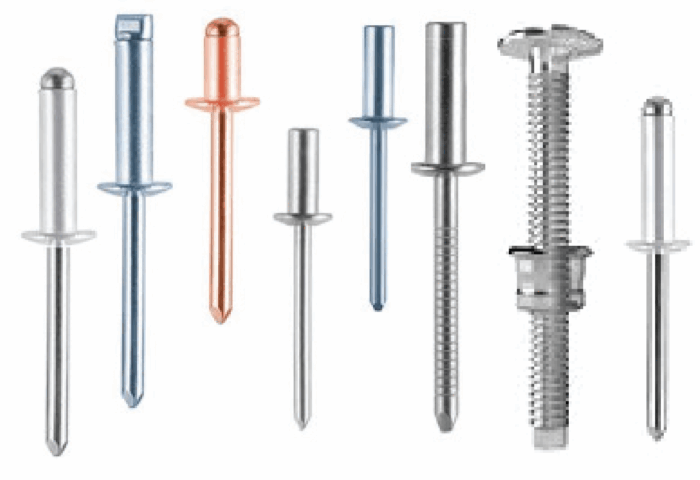
A blind rivet is a one-sided mechanical fastening solution used to permanently join two or more materials together. Unlike bolts and nuts that require access to both sides, blind rivets are installed from only one side of the workpiece, making them ideal for thin sheet metals, plastics, composites, and other materials where backside access is limited or impossible.
How Blind Rivets Work
A blind rivet is made up of a tubular body, a head, and a mandrel:
- A hole is pre-drilled through the materials you want to join.
- The blind rivet is inserted into that hole.
- A rivet installation tool pulls the rivet mandrel while holding the rivet body in place.
- As the rivet mandrel is pulled, the rivet body expands and compresses against the backside of the material.
- Once the correct clamp force is reached, typically the mandrel snaps off, leaving the rivet body permanently in place and the materials tightly joined.
This one-sided (sometimes called “blind to the backside”) installation makes blind rivets quick to set—often in just seconds—and requires no finishing work after installation.
What makes Blind Rivets a good choice for your application?
One-Sided Installation:
Blind rivets are inserted and set from the accessible side of the assembly, making them extremely useful for enclosed or hard-to-reach applications.
Permanent, Vibration-Resistant Joints:
Once installed, blind rivets create a permanent mechanical bond that resists loosening in most environments with vibration or movement, such as in truck trailers (rivets are famous for being the fastener of choice to hold the walls together on 18-wheeler trailers).
Compatibility with Thin or Fragile Materials:
Because blind rivets expand to clamp materials without requiring a nut on the backside, they help prevent material distortion or failure in thin sheets and composites.
Fast and Efficient Installation:
Blind rivets are designed for rapid installation with minimal tools—manual, pneumatic, or cordless—boosting production speed and lowering labor costs.
No Backside Access Required:
This makes blind rivets ideal for structures like aircraft skins, automotive panels, electronics enclosures, handicapped spaces, and more.
What are some common types of Blind Rivets?
Blind rivets come in a variety of types to meet different functional needs:
- Standard Blind Rivets: General-purpose option for light-to-medium duty fastening. These rivets come with a standard flange-dome head and a large flange or countersunk head.
- Structural Blind Rivets: Higher strength options designed to handle heavier shear and tensile loads.
- Multi-Grip Blind Rivets: Flexible grip range for joining materials of varying thicknesses, so OEMs can stock fewer parts/SKUs of rivets.
- RIVQUICK® Rivets: Designed by Bollhoff, these blind rivets have a thin wall that offers fastening in a variety of materials, including metals, composites, and plastic. A variety of product types are available.
- Solid Rivets: Permanently fasten two or more pieces of metal using pre-punched or pre-drilled holes. Some options are available in copper, aluminum, brass, stainless steel, and steel. (These are not “blind” to the backside, they do require access to the backside to install, sometimes referred to as the original “rivet”).
- Drive Rivets: In most cases, these rivets are shorter than other rivets and can be used with wood, metal, plastic, and other materials. The only tooling needed for installation is a hammer to “drive” the pin through the material.
- QuickRivets: Pre-install of the rivets isn’t necessary, so they install up to 4x faster than traditional methods.
- SupraTITE® Rivets: These are a brand by Industrial Rivet (RivetKing®), and are a fast and efficient way to install rivets when only one side of the application is available.
- Rivinox® and Rivibulb®: Rivets that can help form strong, vibration-resistant connections while maintaining a clean, finished look on both sides of your application.
- Lockbolt Collar Rivets or Huck® Bolt: A two-piece system using a “bolt” and “collar”. Because of the two-piece design, access to the backside is required. Once installed, the Lockbolt Collar Rivet or Huck® Bolt creates a permanent secure swedged joint. The Huck® Bolt is a brand offering by Huck®, the Lockbolt Collar Rivet is the generic name made by several over rivet manufacturers.
Applications
Blind rivets are widely used in industries like:
- Datacenters
- Aerospace
- Automotive
- Marine
- Transportation, including heavy truck, semi-trucks, and trailers
- Construction and Metal Fabrication
- Appliances Electronics

Read our article on how rivets help transport goods across America!
Blind Rivets are commonly used for assembling sheet metal panels, attaching brackets, joining thin frames, and permanent fastening where maintenance access isn’t required. If you have questions about what blind rivet are the best for your project or would like us to quote a part, please contact Rivet Nut USA™, a division of Cardinal Components, Inc., to work with one of our fastener experts!